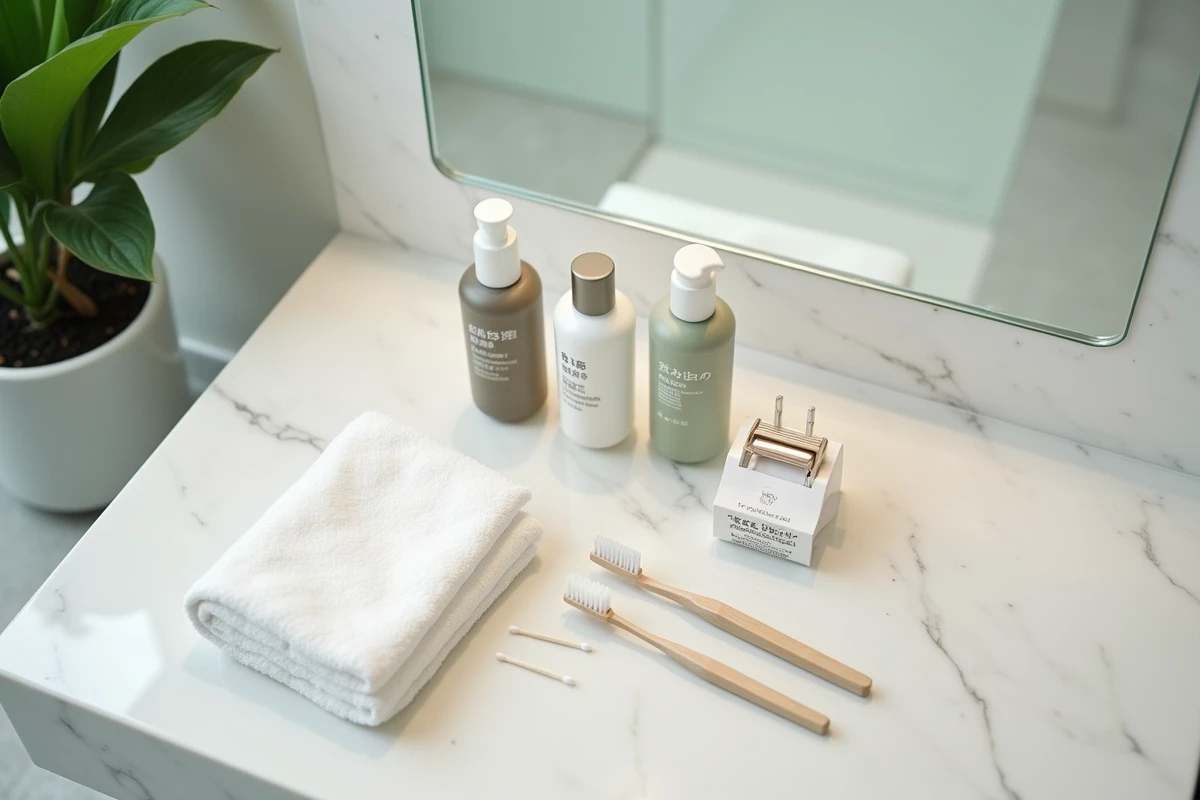
Shampoo, toothbrush, slippers: the list of products provided in a hotel room in Japan often surprises Western travelers with its extent. However, the exact contents of the toiletry kit vary greatly depending on the type of establishment, price range, and, recently, local regulations on plastic packaging. This article compares what business hotels, international chains, and traditional ryokan actually provide.
High-tech toilets and bulk dispensers: what’s changing since 2025
The most striking fact for a European visitor is not the contents of the vanity but the toilets themselves. The vast majority of Japanese hotels, including in the business and capsule segments, feature Washlet toilets (Toto or Panasonic) with water jets as standard equipment. This generalization reduces dependence on toilet paper and alters the sanitary experience as soon as one enters the room.
Another recent development: a municipal ordinance in Tokyo, effective January 2026, requires three-star hotels and above to offer rechargeable bulk toiletries (shampoo, shower gel). The goal is to reduce disposable plastic packaging. In practice, small individual bottles of 30 ml are tending to disappear in favor of fixed wall dispensers in showers. For a detailed overview of the toiletries provided in Japan, this resource covers the differences by accommodation category.
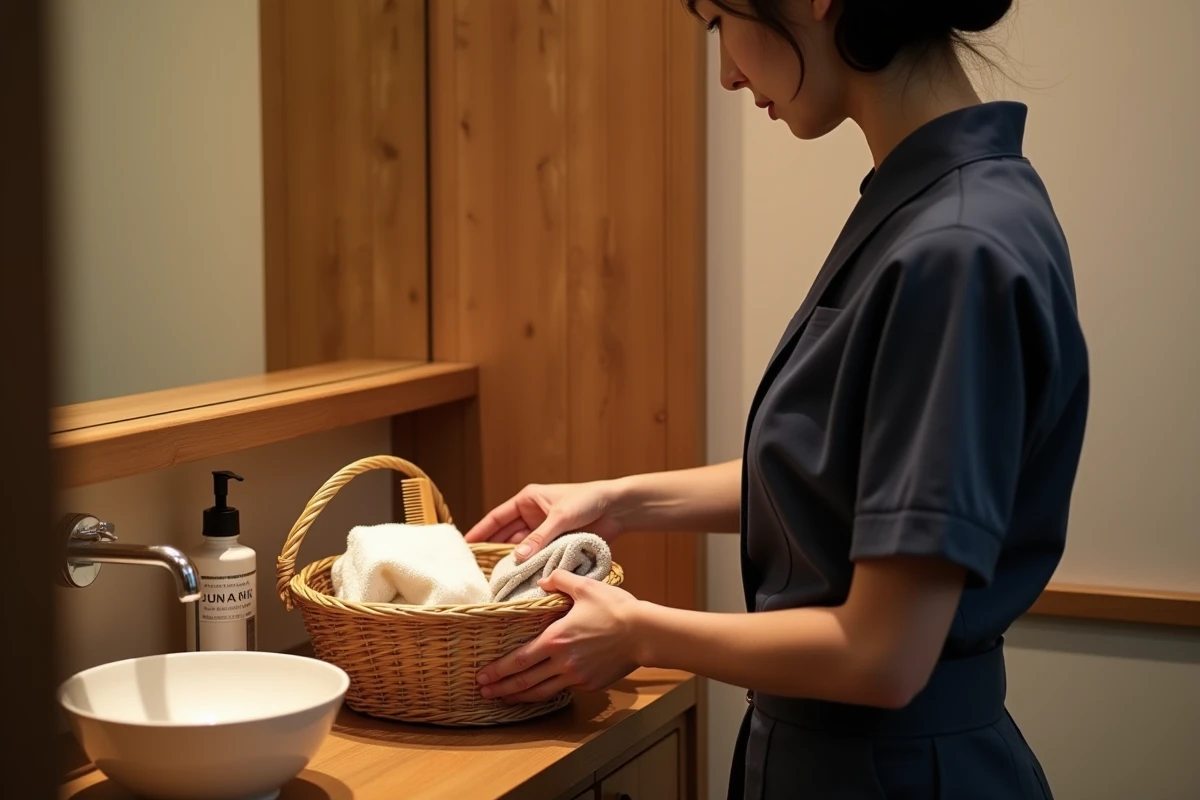
Business hotel, international chain, and ryokan: comparative table of provided products
The gaps between accommodation categories are clear. The table below summarizes the products commonly found according to the type of establishment.
| Product | Business Hotel | International Chain | Traditional Ryokan |
|---|---|---|---|
| Shampoo / conditioner | Wall dispenser (bulk) | Individual bottles or bulk | Local bottles or onsen bulk |
| Shower gel / soap | Wall dispenser | Wrapped soap or dispenser | Handmade herbal onsen soap |
| Toothbrush + toothpaste | Yes (individual kit) | Yes | Yes |
| Disposable razor | Yes | Yes | Variable |
| Comb / brush | Yes | Yes | Yes |
| Cotton swabs | Yes | Yes | Variable |
| Slippers | Yes | Yes | Yes (often fabric) |
| Yukata / pajamas | Common | Classic robe | Traditional yukata |
| Skincare kit | Common (Shiseido, Kao) | Variable (global brands) | Rare (thermal products) |
| Washlet toilet | Almost systematic | Yes | Common |
One of the most telling gaps concerns skincare. Japanese business hotels often provide a small kit including lotion, emulsion, and facial cleanser, usually from the Shiseido or Kao brands. International chains (IHG, Marriott) tend to favor their partnerships with global brands like L’Occitane.
Hypoallergenic products and Japanese brands: a little-known standard in Europe
Travelers with sensitive skin benefit from an advantage rarely mentioned in guides. The majority of Japanese hotels visited after 2025 offer hypoallergenic fragrance-free products, primarily from Shiseido or Kao. This orientation differs from the European hotel market, where scented formulas remain the norm.
This choice is not trivial. Japanese formulations for hospitality prioritize lightweight textures and short compositions, suitable for reactive skin. For those prone to irritation, the risk of adverse skin reactions is reduced compared to products provided in Western chains.
- Facial cleanser and moisturizing lotion: present in most business hotels, absent from international chains except in higher-end ranges
- Sulfate-free shampoo: increasingly common in wall dispensers since the switch to bulk
- Fragrance-free solid soap: common in ryokan, often made from local thermal ingredients
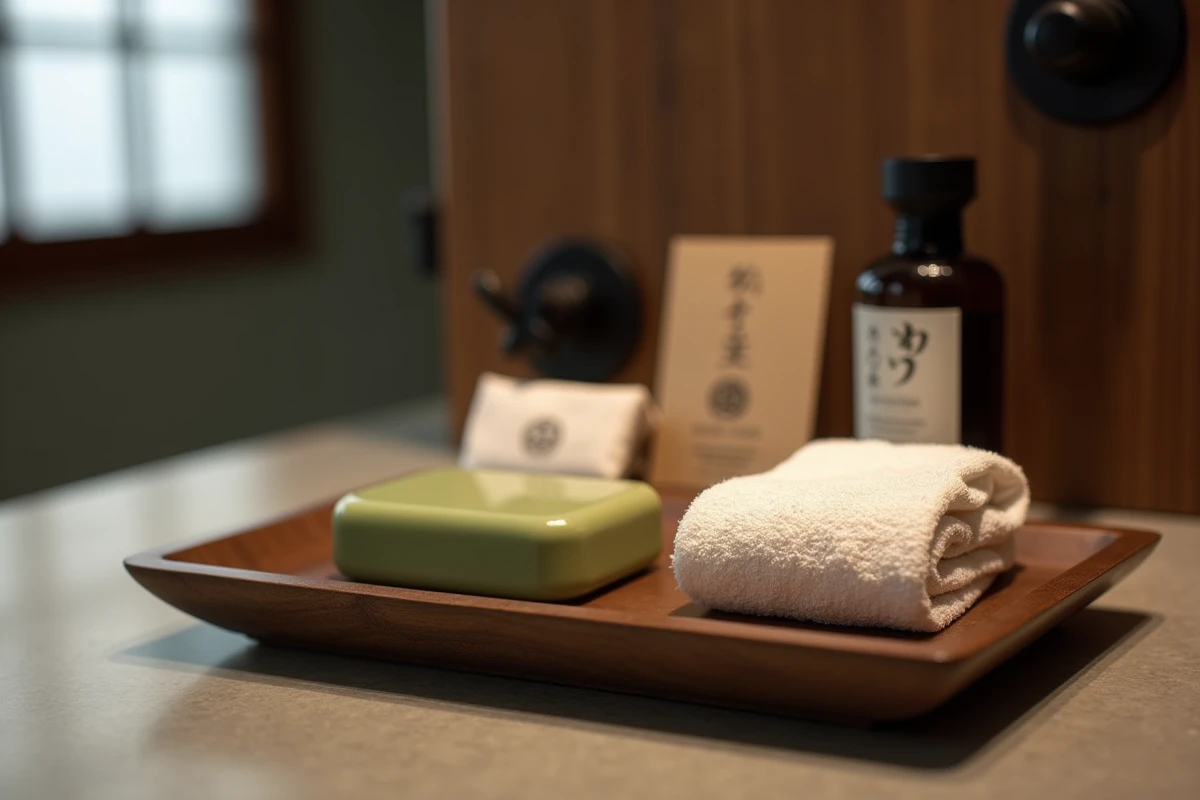
Ryokan and traditional inns in Kyoto: products related to thermal bathing
Ryokan stand out for their cultural approach to bathing. Products are not chosen for their brand but for their connection to local hot spring water. According to the National Ryokan Association, these establishments prioritize handmade soaps made from onsen herbs rather than international references.
In a ryokan in Kyoto or the Hakone region, one often finds a folded yukata on the bed, fabric slippers, and a small cotton towel (tenugui) in addition to the standard bath towel. The tenugui serves both for public bathing and quick drying, and is an integral part of the onsen ritual.
The indoor public baths (ofuro) of ryokan provide shampoo and soap in dispensers, but guests sometimes bring their own products out of cultural habit. This detail surprises foreign travelers who expect to find individual shower stalls equipped.
What to still pack in your suitcase
Despite the generosity of Japanese hotels in terms of toiletries, a few products are almost systematically missing:
- Deodorant: rarely provided, regardless of the establishment’s standing
- Sunscreen: absent from hotel kits, including in ryokan
- Specific hair products (mask, oil): wall dispensers are limited to basic shampoo and conditioner
- Shaving foam: the disposable razor is provided alone, without foam or gel in most cases
Japanese hotels cover the essentials of bathing and daily care with a quality of product above the global average. The Japanese basic kit goes further than its European equivalent, notably thanks to facial care and systematic slippers. However, body hygiene products outside the shower (deodorant, sunscreen) remain to be brought by oneself, regardless of the hotel category chosen.